This week, during a conference call, someone asked Rob Orrison, Neil Chatelain, and me, “Which figure from the Revolution is ERW most like?”
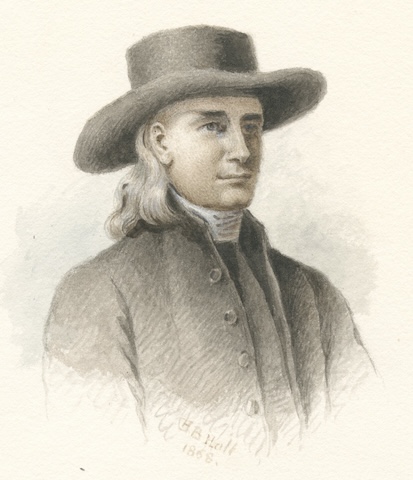
Stephen Hopkins
The first person who jumped to mind was Stephen Hopkins of Rhode Island. Although none of us wears a cool hat like Hopkins does, it was easy to think of ERW as the guy in the back of the room, drinking a mug of rum or beer or grog and offering commentary on events. Hopkins had served several stints as Rhode Island’s colonial governor and served as chief justice of the colonial court during the infamous Gaspée affair. He was good natured and earnest, and John Adams said, “He kept us alive” with his energy. “Hopkins never drank to excess,” Adams said, “but all he drank was immediately not only converted into Wit, Sense, Knowledge and good humor, but inspired Us all with similar qualities.”
Or how about John Adams, as Rob suggested? (He knew I’d love that one!) Not only was Adams a writer, he was also a workhorse, like most of the regular contributors who keep ERW going—a small cadre of folks who each do a lot of work. Adams was also prickly, Rob pointed out, just as many of ERW’s folks are (a bit of self-revealing honesty there!). Adams preferred beer to cider, so I thought we’d have to swap that out, but Rob reminded me that few of us would turn down free cider.
I suggested Ben Franklin. Franklin had a background in printing and writing—something central to ERW—and was also generally good humored. He liked to have a good time—“Perhaps too good of a time,” someone in the conversation piped in—and always situated himself at the social center of any scene. ERW is, if nothing else, social. Rob did point out that Franklin was a genius in many, many areas, while ERW is pretty focused in its work, but personality wise, it’s a good match.
The question put us on the spot, so those were our initial answers. What do YOU think? If ERW was a figure from the Revolution, who would ERW be most like?
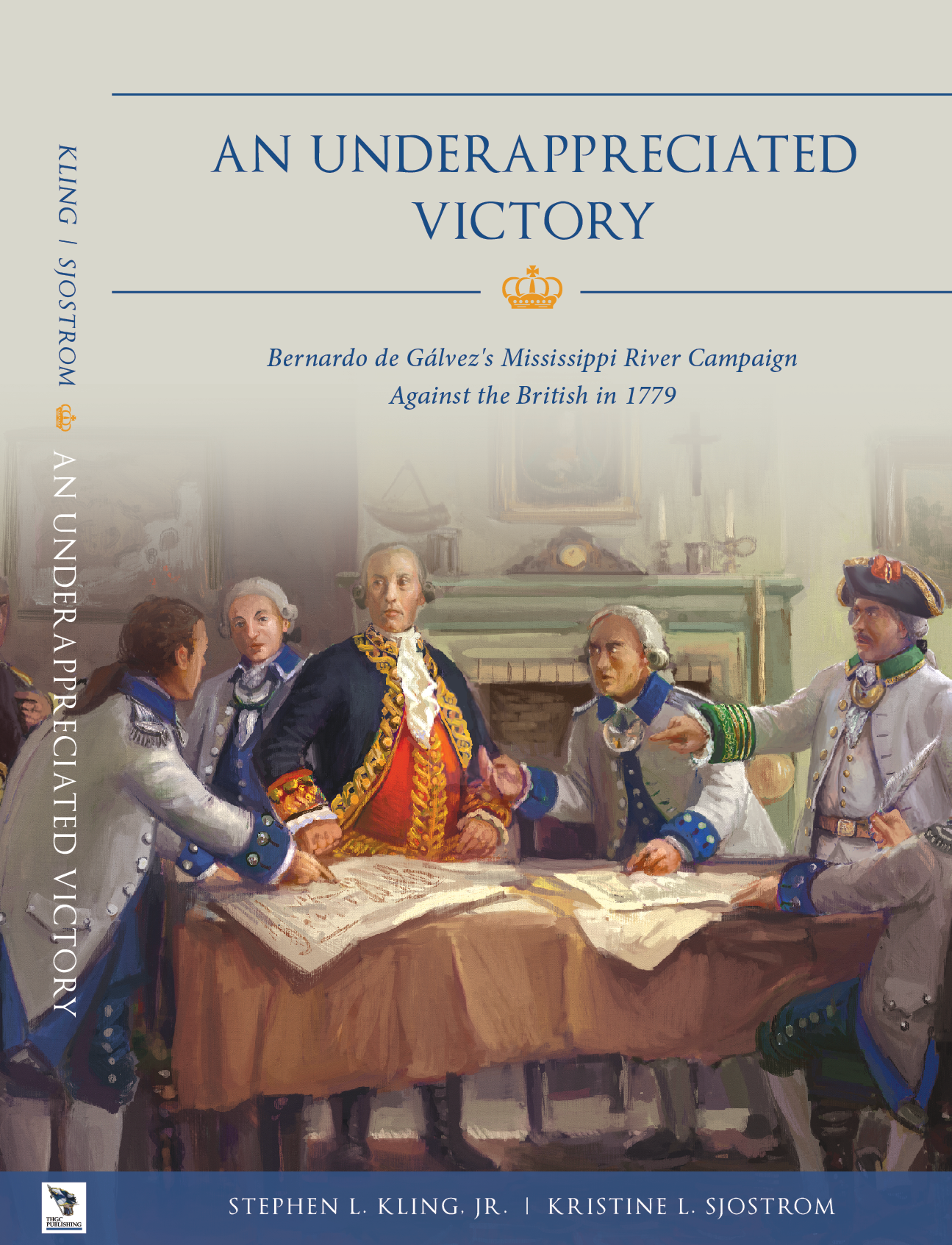
The American Revolution is often remembered through the familiar lens of successful campaigns and their contributing commanders: General George Washington at Yorktown, Virginia, and General Horatio Gates at Saratoga, New York, to name two of the most significant. Yet the Revolution was an international conflict fought across a much wider geographic area than just along the eastern seaboard of North America. In An Underappreciated Victory, Stephen L. Kling, Jr. and Kristine L. Sjostrom seek to restore one of these overlooked campaigns to its proper place in the history of the war. Their study of Bernardo de Gálvez’s 1779 Mississippi River campaign demonstrates how Spain, despite pursuing its own strategic interests, contributed materially to the defeat of Britain and how Gálvez’s leadership produced significant results with remarkably limited resources.
The authors begin by establishing the strategic importance of Spanish Louisiana and the Mississippi River Valley. Following Spain’s entry into the war against Britain in 1779, Louisiana became both a potential target for British operations and a valuable base from which Spain could threaten British possessions. New Orleans was particularly vulnerable. British control of posts along the Mississippi posed a danger to Spanish interests while also threatening communications and commerce throughout the region. Rather than remain on the defensive, Gálvez recognized an opportunity to seize the initiative.
It is in this decision that the authors make one of their strongest arguments about Gálvez’s leadership. His forces were hardly overwhelming, and the campaign presented formidable logistical challenges. Distance, weather, disease, difficult terrain, transportation problems, and uncertain intelligence, all complicated operations. Gálvez nevertheless chose an offensive strategy. His willingness to act before the British could concentrate their forces became one of the campaign’s defining characteristics. The resulting operations against British positions, culminating in the capture of Baton Rouge and other posts, demonstrated the effectiveness of surprise, mobility, intelligence, and decisive leadership.
Kling and Sjostrom are very effective in showing that the campaign cannot be understood solely through its engagements. Logistics and geography receive significant attention, revealing the extent to which environmental conditions shaped military possibilities along the Mississippi River. The campaign’s success therefore becomes more impressive when measured against the obstacles continuing to confront Gálvez. His achievement was not simply that he defeated British forces; it was that he managed to organize and sustain an offensive in an environment that severely restricted the movement and supply of armies.
Another of the book’s greatest strengths is its use of multinational sources. By incorporating Spanish, British, and German accounts, the authors move beyond the predominantly Anglo-American perspective that has traditionally dominated Revolutionary War narratives. These sources allow them to reconstruct events from competing viewpoints and provide greater insight into the decisions made by both sides. Their documentary approach also strengthens the case for reconsidering Gálvez’s campaign as a serious military operation rather than an isolated episode on the margins of the Revolution.
The book’s greatest historiographical contribution, however, lies in its reassessment of Spain’s role in the American Revolution. Spain did not enter the war solely to assist the American colonies; it had territorial, commercial, and geopolitical objectives of its own. Nevertheless, those objectives frequently aligned with the interests of the American revolutionaries. Gálvez’s campaign illustrates how Spanish military operations diverted British attention and resources while weakening British control of the Gulf Coast and Mississippi Valley. The authors therefore broaden the traditional interpretation of the Revolution from an Anglo-American struggle supported by France into a genuinely international conflict.
The study is not without potential limitations. This book is a deep and exhaustive study of a particular subsect of war, designed to be the volume on this aspect. Similarly, the authors’ admiration for Gálvez occasionally raises the question of whether they attribute his successes too heavily to exceptional leadership rather than to a combination of favorable circumstances, British weaknesses, and Spanish strategic interests. Nevertheless, the evidence presented makes a convincing case that Gálvez exercised considerable initiative and understood the advantages of striking quickly against dispersed British positions.
Ultimately, An Underappreciated Victory shows that the importance of a military campaign cannot always be measured by the size of participants or soldiers. Gálvez’s 1779 Mississippi campaign involved relatively modest forces compared with the armies that fought at Saratoga or Yorktown, yet its strategic consequences were considerably greater than its obscurity might suggest. Kling and Sjostrom provide a valuable reconstruction of the campaign while challenging readers to reconsider the geographic and international dimensions of the American Revolution. Their study establishes Gálvez not merely as a peripheral Spanish commander but as an important participant in the broader struggle against Britain. In doing so, An Underappreciated Victory makes a persuasive case that the campaign—and Gálvez himself—deserve a more prominent place in the history of the American Revolution.
THGC Publishing, St. Louis, MO 2026 634 pages, including images $50.00
On August 27, 1776, in Brooklyn, New York, a small contingent of Maryland soldiers showed the world what valor and patriotism looked like. During one of the largest and bloodiest battles of the Revolutionary War, the actions of these brave soldiers would earn them the venerated name of the Maryland 400.
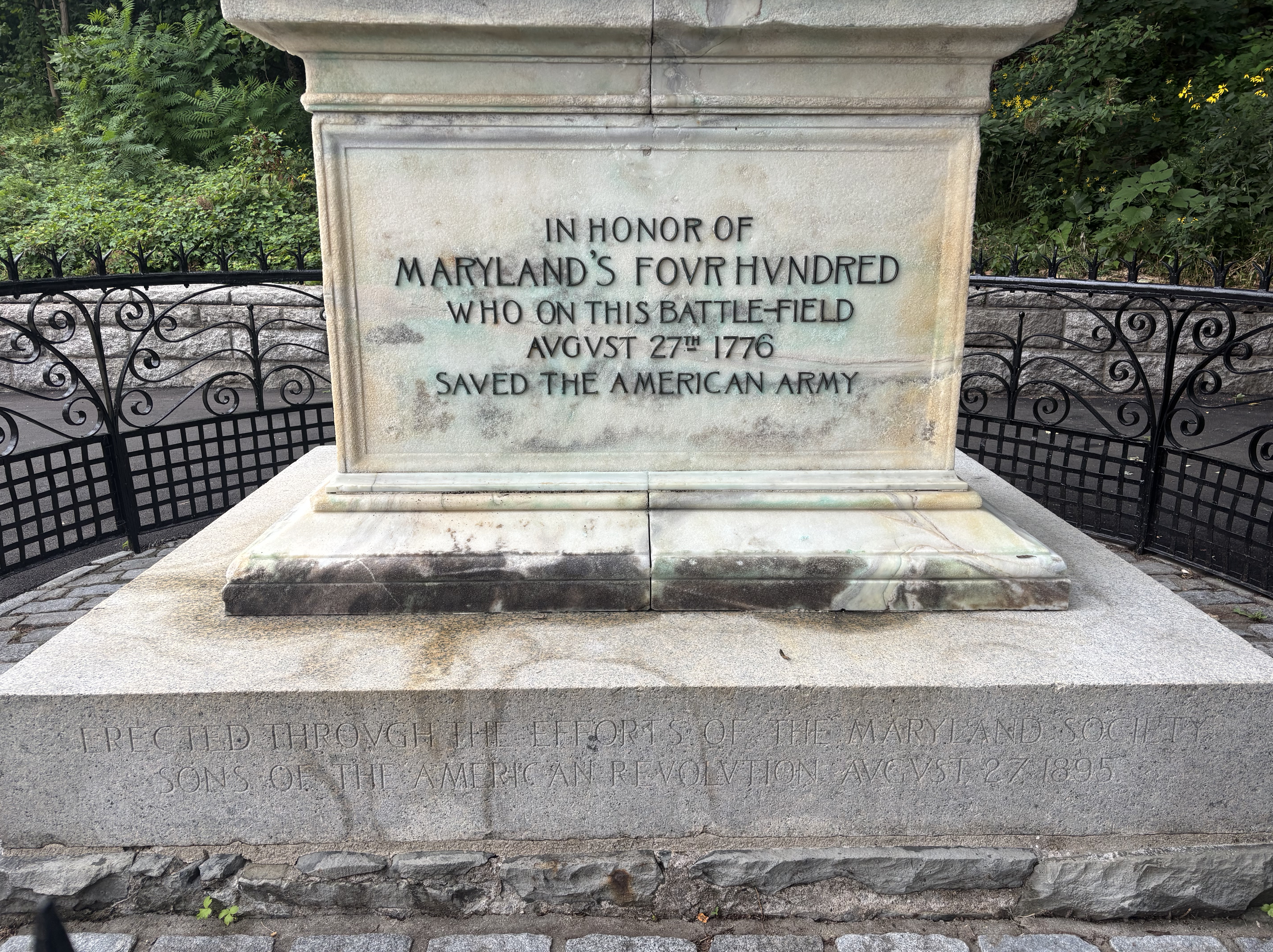
The Maryland 400 monument in Prospect Park on August 27, 2026. (Author photo)
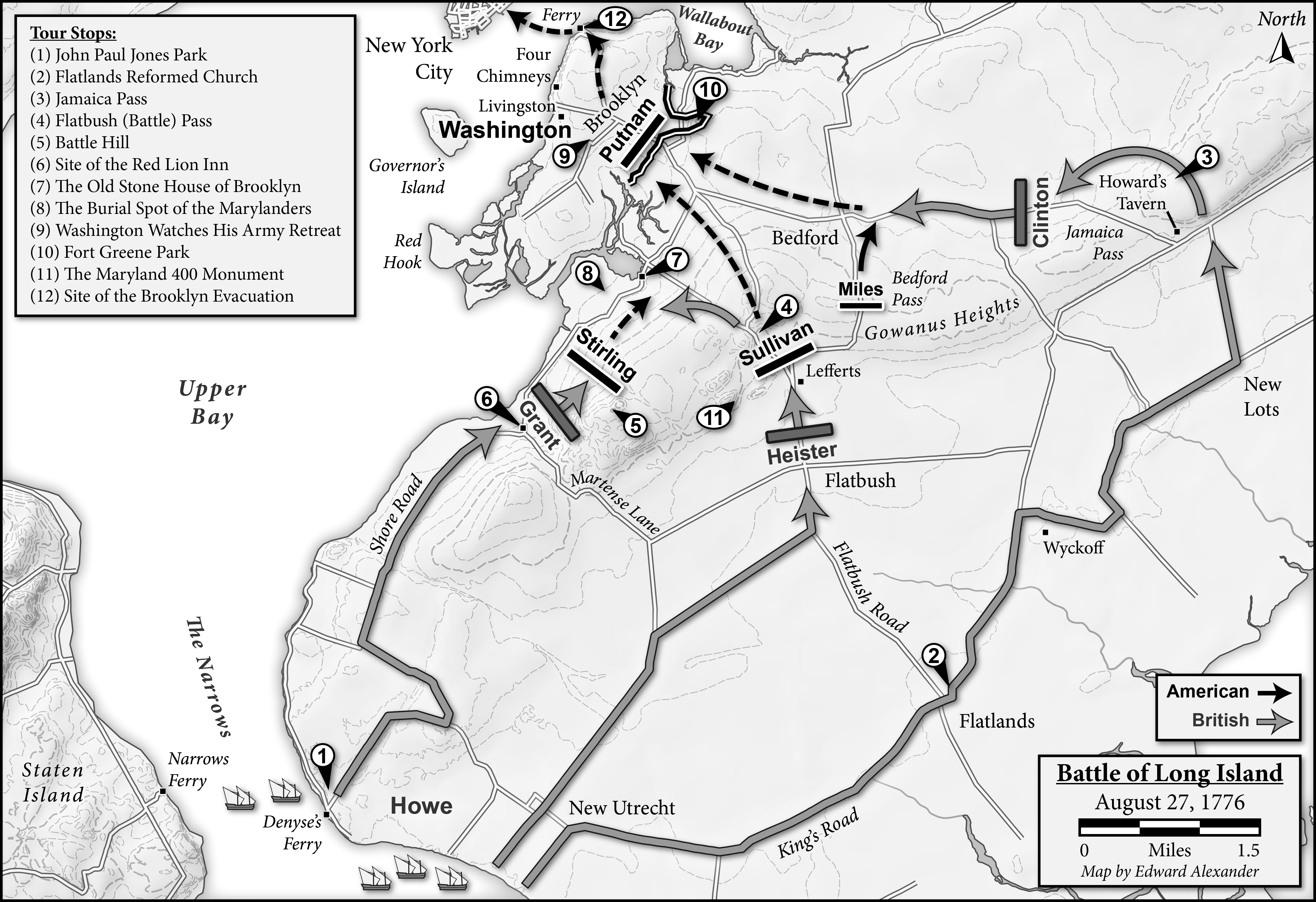
At the Battle of Long Island, the American Army was strung out in a long line across modern day Brooklyn facing south, with Washington and his headquarters located at Brooklyn Heights. However, Washington and the Americans had failed to guard the extreme left flank of the American line. As a result, British General William Howe divided his army in two, attacked the American main line head on to hold them in position, while British Generals Charles Cornwallis and Henry Clinton marched around the American flank and attacked from the east.
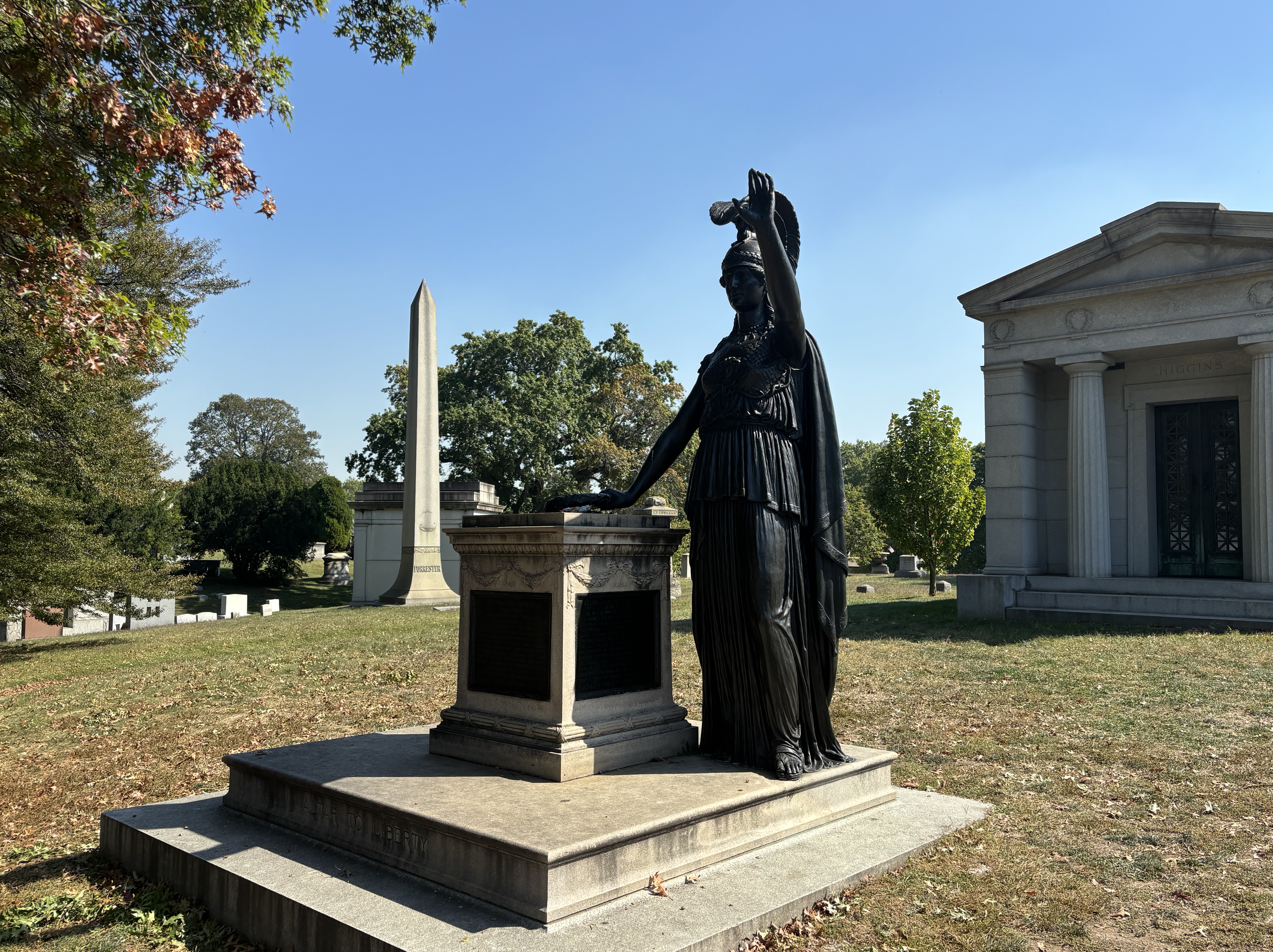
A statue of Minerva stands on Battle Hill in Green-Wood Cemetery with one hand placed on the Altar of Liberty, while her other hand salutes the Statue of Liberty in New York Harbor. (Author photo)
As the battle played out during the day of the 27th, the men of the 1st Maryland Regiment, under the temporary command of Major Mordeci Gist, were positioned on the right flank of the American Army, near present day Green-Wood Cemetery. Gist’s men were in General William Alexander’s (Lord Stirling’s) brigade. Stirling’s men were engaged heavily that morning as they fought the diversionary force in their front. The battle raged on what is today known as Battle Hill, and the Americans felt confident they were winning the day’s battle.
A new map of the Battle of Long Island from the book Conquer or Die: The 1776 New York Campaign by Mark Maloy and Dan Welch.
Late in the morning though, the Marylanders began to hear the sounds of musketry and cannon fire coming in from their left and rear. They soon realized that the American position had been flanked and that they would soon be totally surrounded and annihilated. They were immediately ordered to retreat. They fell back to the banks of Gowanus Creek, which had to be crossed to reach the relative safety of Brooklyn Heights. The bridge across the Creek had been burnt and the Americans would have to swim across to escape. As the Americans stood looking at the Creek, Cornwallis and his Light Infantry appeared and began to fire on the retreating American soldiers. Cornwallis sent some of his men to occupy an old stone house (the Vechte-Cortelyou House) near the creek and fire into the panicking men. At this critical juncture, with the whole of Stirling’s brigade about to be crushed, Stirling ordered Gist’s men to charge the British line.
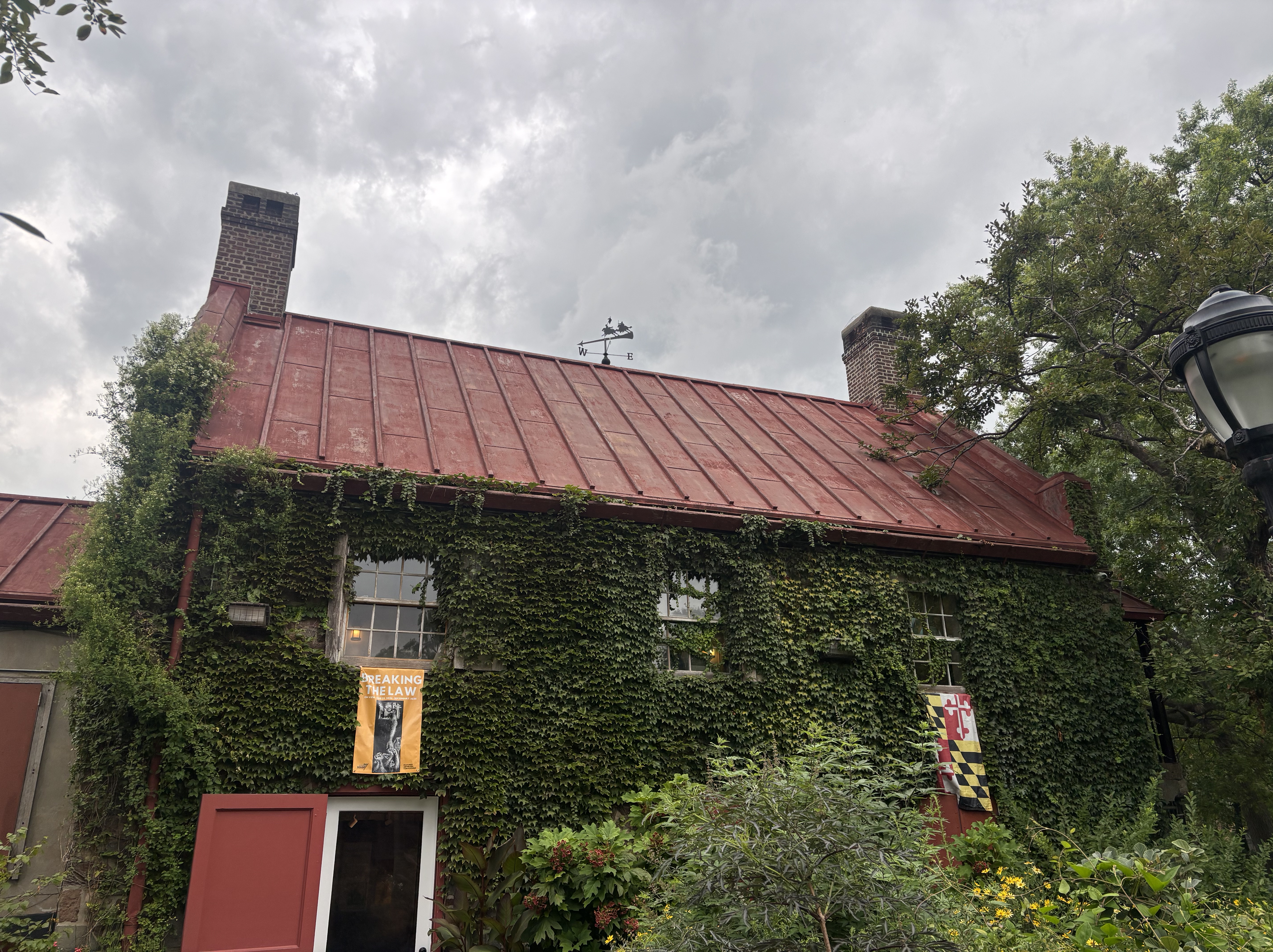
The Vechte-Cortelyou House on August 27, 2026. Today it is known as the Old Stone House in Brooklyn. This is a reconstruction of the original building, using the original materials. While most of the Brooklyn battlefield is unrecognizable from 1776, this building stands as a reminder of the borough’s Revolutionary War history and has a museum located inside it. (Author photo)
It was an impossible task, and Gist and his soldiers probably knew it too. Gist, with less than 400 men was to assault the vanguard of an entire British division, numbering at least 2,000 men with artillery. But, Stirling needed something to allow his division to escape into Brooklyn Heights. He himself would stay and fight with this rearguard. The Marylanders, in their first real battle, didn’t hesitate at all. Closing up their ranks, the Old Line pushed forward into the hailstorm of lead numerous times. As musket balls thinned their lines, the Marylanders would fall back, reform and strike again. On a hill at Brooklyn Heights, Washington watched the action in his spyglass. “Good God! What brave fellows I must this day lose!” he exclaimed as he witnessed the sacrifice of some of his best soldiers.
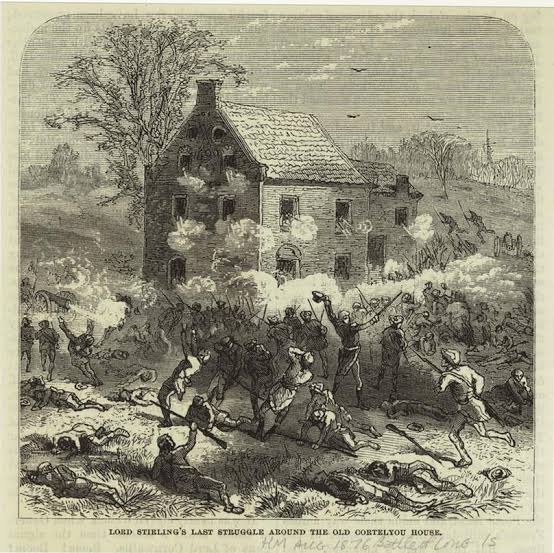
A 19th century image of the fighting by the Marylanders at Brooklyn. (New York Public Library)
The brash and bold attacks had the exact effect Stirling needed. The British, temporarily stunned by the attacks, paused to fight this small contingent of soldiers. Meanwhile the remainder of Stirling’s men successfully crossed Gowanus Creek and arrived in the main American lines. General Stirling, still fighting from horseback was eventually surrounded and captured by some Hessian soldiers.
After a sixth and final charge by the Maryland troops, Gist’s command had been effectively destroyed. Gist and a handful of his men finally fell back and crossed Gowanus Creek themselves. The Marylanders had helped many American troops escape capture and death, and also caused a diversion that stopped any possible assault on the main American position at Brooklyn Heights. Gist and a few dozen survivors had made it back to the main army, but back on the fields around the Vechte-Cortelyou House 256 Marylanders lay dead or dying. It was one of the highest number of casualties a regiment would lose in the war.
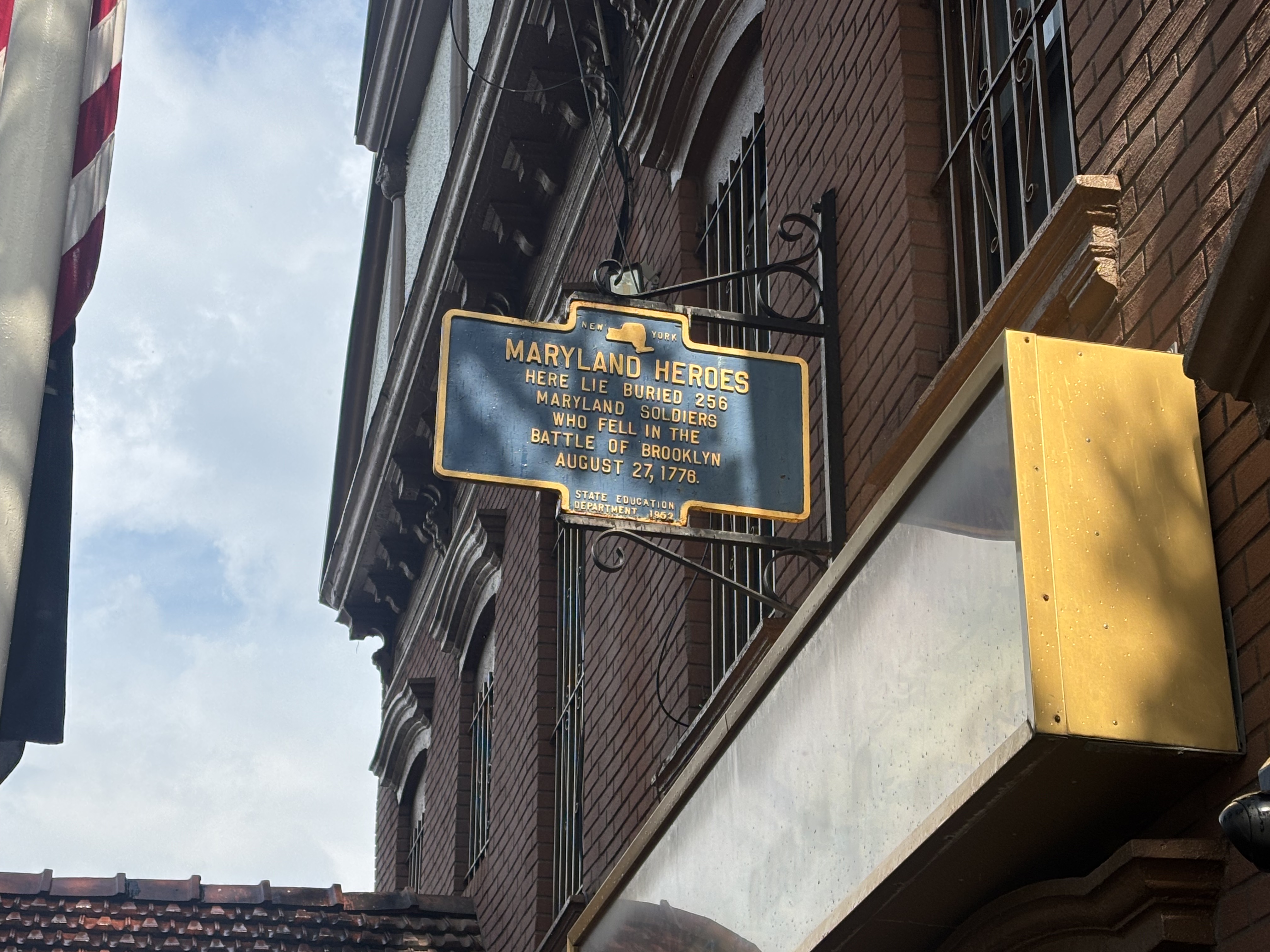
An old metal sign at an American Legion post in Brooklyn on August 27, 2026 denotes the possible burial location of the 256 Marylanders. (Author Photo)
The battle was all but over. It appeared that the 9,000 Americans who were now holed up on Brooklyn Heights would all be captured, but Washington successfully evacuated the entire army over to Manhattan. The war would continue for seven more years and end with independence for America, but that may not have been the case had the Maryland troops not sacrificed themselves for the fellow men, and bought the American Army precious time.
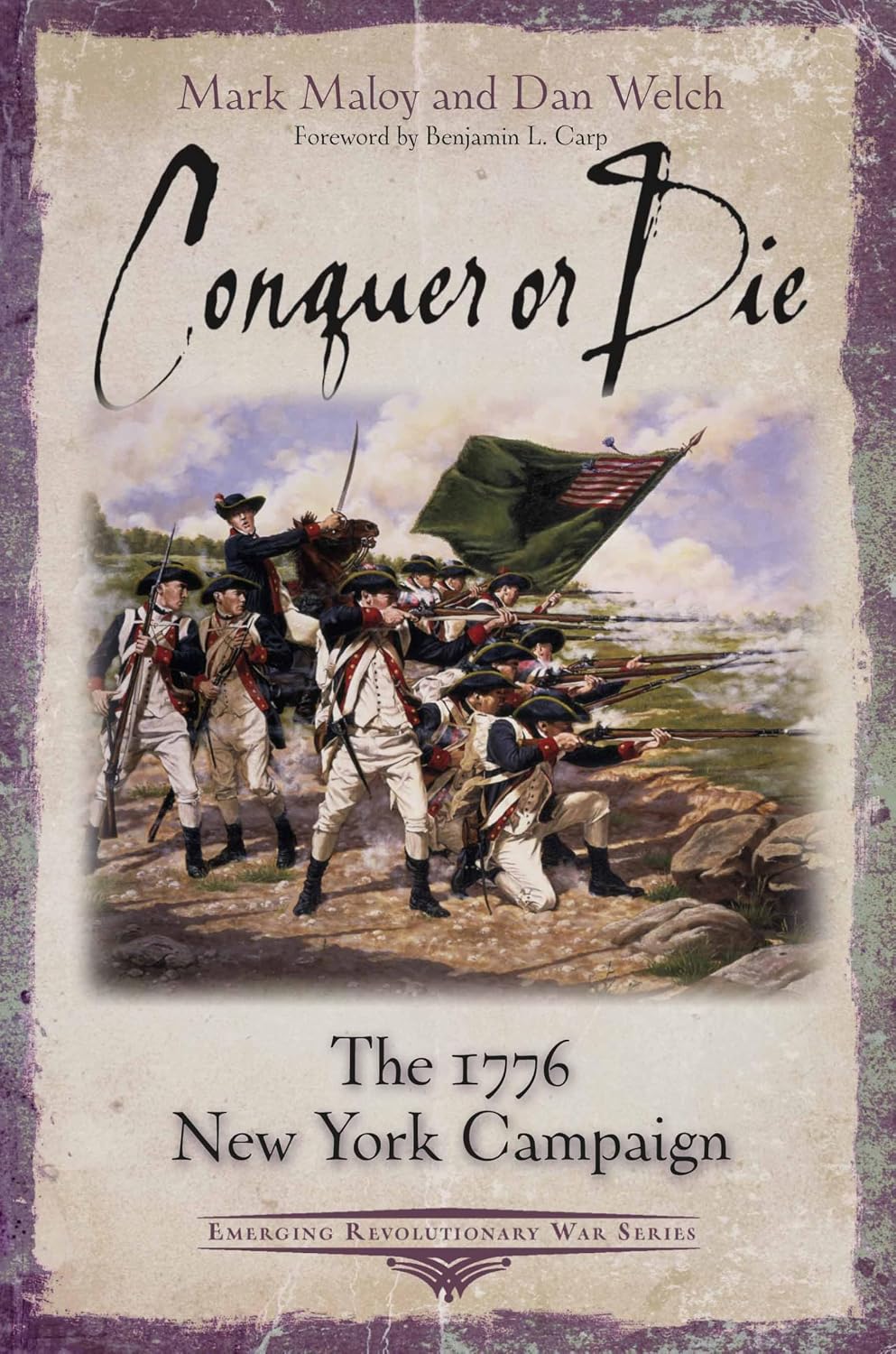
Cover of the upcoming book Conquer or Die: The 1776 New York Campaign.
250 years later, many New Yorkers walk throughout the Park Slope neighborhood, unaware of how hallowed the ground is they tread on. Thankfully, people are doing more to bring this history to light. This past weekend a reenactment of the battle was held in Brooklyn’s Prospect Park and at the Old Stone House museum. Check out Emerging Revolutionary War’s realtime coverage of the fighting on our Facebook page. This November Emerging Revolutionary War’s Mark Maloy and Dan Welch will release a new book about these battles and the places you can visit today. Check out the new book Conquer or Die: The 1776 New York Campaign and pre-order it today! This August 27, remember the brave men of the Maryland 400 and the freedom they died for.
The New York Campaign had been building for over year by August 1776. In July 1775, previous British commander of forces in America, Thomas Gage, had sent a request to his superiors to be allowed to leave Boston and begin a new campaign in New York. Following Lexington, Concord, and Bunker Hill, Gage’s force remained bottled up and besieged in and around Boston and Charleston. When word of approval of Gage’s plan reached Boston, so too did orders relieving him of command. Before he departed for England in October 1775, he met with his successor, William Howe, and greatly stressed the importance of moving the theater of war to New York. Howe would follow Gage’s preplanning and approval to the letter, including waiting until the spring to began the shift in the army’s base of operations. Howe’s timetable, however, was moved up after the arrival of Henry Knox’s artillery train and the placement of guns on Dorchester Heights. On March 17, 1776, Howe and 11,000 troops and Loyalist citizens sailed for Nova Scotia. Foreshadowing the British departure and the location of the next campaign in a letter written two days before they set sail, Col. Joseph Reed, later George Washington’s adjutant-general, correctly asserted, “If Howe should leave Boston, we expect he will make for New York; and, at all events, we look upon that as one of the scenes of the summer business.”
Meanwhile, George Washington also looked to New York as the next seat of this growing conflict. In January he sent Charles Lee to begin laying out a position for the Continental Army to take once it shifted southward from Boston. Not long after Lee arrived in February 1776 he assured the Committee of Safety that even though he could see no way to make New York into a “tenable fortification” he could make a position strong enough to be “a most advantageous field of battle” that would “cost the enemy many thousands of men to get possession of it.” Just two months later, on April 13, Washington and the Continental Army arrived.
The Continental Army commander had no other choice than to do what he could in New York. There was immense political pressure on Washington not to abandon it, the Congress believing it had high political and psychological value. Many in Congress believed abandoning it would demoralize the Patriot cause and swell the morale of the Loyalist population in the city and colony thereof. Furthermore, it was a central location along the Atlantic coast and a conduit of communication and supplies between New England and the southern colonies via the Hudson River. Furthermore, the Hudson River/Lake Champlain corridor remained a vital passage to Canada and the Great Lakes. New York was also a bustling economic hub, the second largest urban center in the colonies, with a port, shipbuilding, and deep-water harbor had immense naval and trade value. Widely considered as the “key to the continent,” Washington would have a difficult task defend the city, it’s deep water port, and the numerous navigable waterways; all reasons the British wanted to seize the city in their effort cutoff New England from the middle and southern colonies. Writing to his brother, John Augustine Washington, between May 31 and June 4, 1776, he confessed, “We expect a very bloody Summer of it at New York . . . & I am sorry to say that we are not, either in Men, or Arms, prepared for it.”
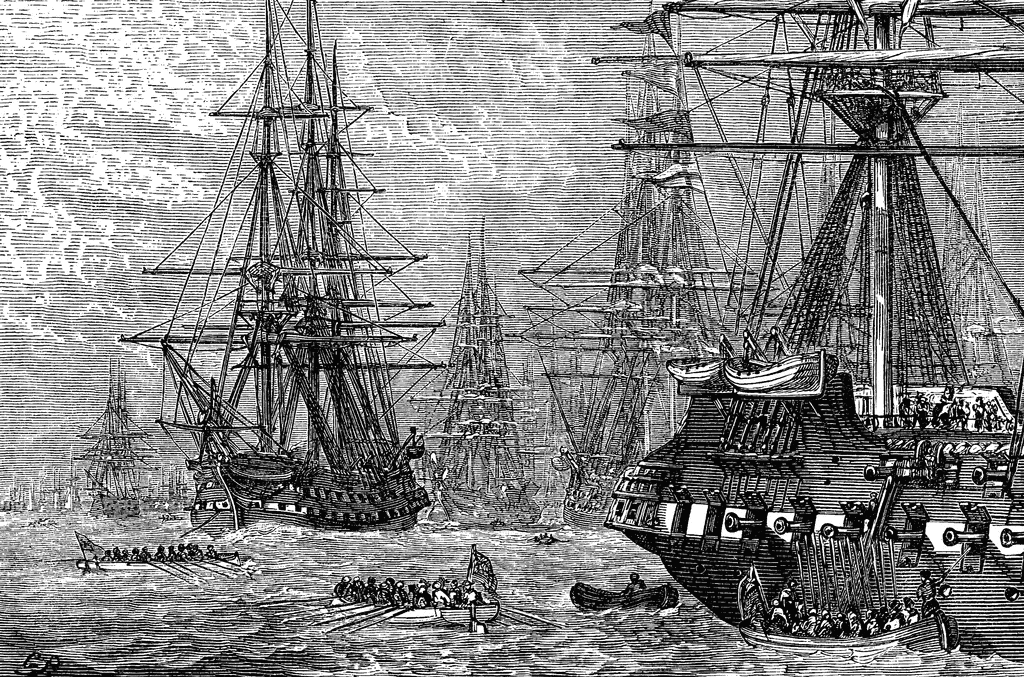
Finally, after several months of resupplying and refitting his army in Nova Scotia, William Howe and his command arrived on Staten Island, unopposed, in June 1776. Pvt. Daniel McCurtin, 1st Company of Maryland Rifles, recorded the British arrival, noting he saw, “the whole Bay was full of shipping as ever it could be. I declare that I thought all London was afloat.”Over the coming weeks he would be joined by his brother, Richard, with large numbers of reinforcements, ships, transports, supplies, and Hessians. Although the two brothers leaned into their role of peace commissioners, attempting to end this growing rebellion through pardons and not bloodshed in July, by August, with no peaceful resolution insight, military preparations moved forward.
On August 20, 1776, British troops began loading onto ships and transports from their Staten Island camps, and 250 years ago today, August 22, 1776, the first British troops landed on Long Island at Denyse’s Ferry. Howe had chosen this site for its richness and crops and plentiful livestock in which to supply his army. Still unsure of Howe’s intentions, and constantly worried about his flank and rear being turned by the British Navy, Washington had spread his army dangerously thin across several islands with waterways separating reinforcements should the need for them arise. Thus, on August 22, Washington only had 3,000 men, John Nixon and Nathaniel Heard’s brigades, and some Long Island militia in which to contest the landing. All they could really do was raise the alarm. By the end of the day 20,000 British troops were on Long Island. Only time would tell, at least for Washington, whether or not this would be Howe’s main push or simply a diversion to another beachhead and main strike.
Learn more about the 1776 New York Campaign with ERW’s forthcoming release, Conquer or Die: The 1776 New York Campaign, by Dan Welch and Mark Maloy. Pre-order here!
From June 28, 1778, until October 1781, there is a gap in major engagements by the main Continental Army under the command of General George Washington. A few minor engagements, at Springfield, Connecticut Farms in New Jersey or Stony Point in New York, occurred. Actions in the Southern Theater occupied much of that period and Newport, Rhode Island became a focal point as well, especially with the French arrival. Historians, especially popular and public historians, tend to quickly cover these approximately three years of war in short order, moving onto the finality.
Yet, these years are important, especially to understand the other facets of warfare, rebellion, and revolution. Diving into the primary sources, from the quill pens of Washington, his fellow generals, staff officers, Continental Congress, and the soldiery that comprised the Continental and militia forces, and one can easily surmise how important those non-major-warfare years were. Luckily for the avid students and enthusiasts of the American Revolutionary War, we now have a concise, richly researched, and impactfully created prose published by Casemate and authored by Jeffrey A. Denman to fill this gap.
A glance at Denman’s biography reveals that he was a public-school teacher and historian who has a resume filled with publications and researched articles. He takes that acquired skill set into this publication, weaving the story, sprinkled with direct quotes and primary source material, for an accurate and compelling overview of the high-stakes of the American Revolution and how success very much so hung in the balance from 1778 – 1781.
At the center is Washington, as the “book tracks…strategic and personal contributions across multiple theaters of war…” (pg. xv). This includes relationships with other military and political leaders, along with the French commander, Rochambeau, in how he “carefully navigated French egos, the paralysis of Congress, and state politics…” (pg. xvii). Yet Denman’s goal is to provide a balanced approach to these years from Monmouth Courthouse in 1778 to Yorktown in 1781, “History proves that Washington was not a great military strategist…committed serious tactical mistakes” but “no man…could match Washington in courage, fearlessness, and devotion to his country.” (pgs. xvi-xvii).
Concluding his introduction, Denman clearly states the purpose of the following pages and why, although no major engagements were fought for over three years under Washington’s command, “this book, focusing on moments and locales rarely chronicled, provides an in-depth and captivating window into how one individual galvanized meager resources to accomplish the extraordinary” (pg. xvii).
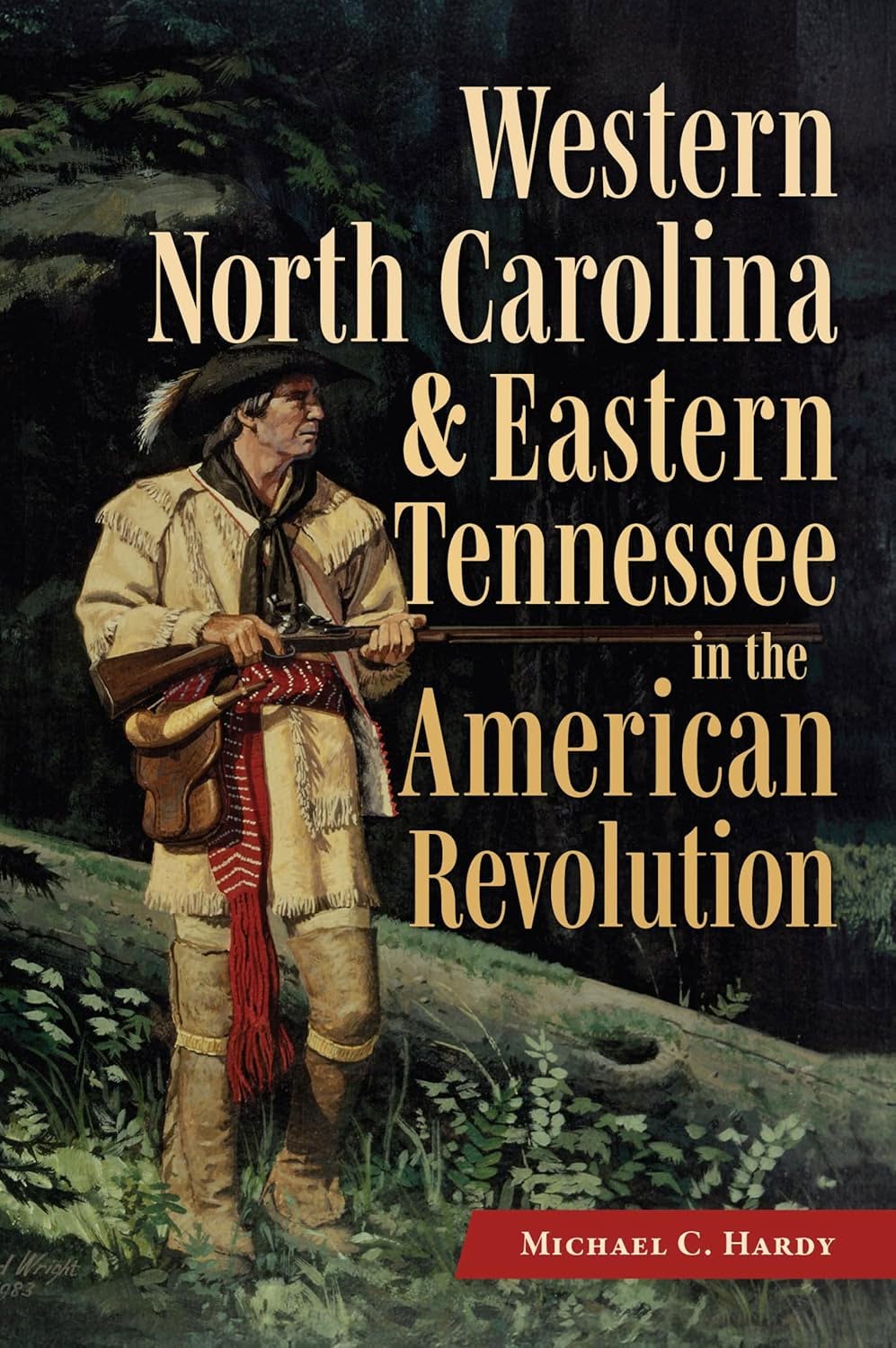
Join us this Sunday at 7pm as we welcome author and historian Michael C. Hardy. Hardy, best known for his many Civil War and North Carolina history published works, he’ll chat with us about the American Revolution in southern Appalachia and the raw and uncertain conflicts that occurred there between Patriots, Loyalists, and Indians. Hardy’s new book “Western North Carolina and Eastern Tennessee in the American Revolution” is now available and worth a read. There are few that know North Carolina history and can tell a story quite as good as Mike can. This Revelry is pre-recorded and will post to our Facebook and You Tube pages at 7pm.
Emerging Revolutionary War welcomes guest historian Tom Elmore.
Throughout history many battles have been decided by little things, sometimes even before the battle. This is true of the Battle of Kings Mountain in South Carolina whose outcome was influenced by a little-known battle about thirty miles away on July 26, 1780, at Fort Thicketty in modern-day Cherokee County, S.C.
The fort was built circa 1769 when local farmer David Anderson converted his barn into a blockhouse outpost. Originally called Fort Anderson, it became known as Fort Thicketty (or Thicketty Fort) after a near-by creek that had unusually thick vegetation along its banks. Though the fort was intended to defend the area population from hostile Native Americans, it mainly saw action against outlaw gangs.[i]
In early June 1780, the fort was occupied by Captain Patrick Moore and his Loyalist followers. Moore was born in Virginia in 1750. Since 1768 he had lived about a mile southwest of the fort along Thicketty Creek. He was described as a fierce, intimidating man who stood six foot seven.[ii]
Moore’s men used the fort as a base of operations for raiding Patriot’s homes and farms. One historian described his men as “politically neither British nor American. They were simply robbers…preying upon defenseless women and children.” Another historian noted that “[Fort Thicketty] became a great place of resort and protection for Tory parties. They would sally forth and plunder Whig families in every direction – so that women and children were often left without clothing, shoes, bread, meat, or salt.” [iii]
During the summer of 1776, news of the Declaration of Independence took time to spread to each of the various states, with some regions getting word faster than others. Many communities held public gatherings to hear the documents read aloud.
The war had been going on for over a year, and now Americans knew what they were fighting for. The final step had been taken: declaring independence.
In Richmond, Virginia, which was not yet the capital of Virginia, the Declaration of Independence was first read on August 5, 1776. A large crowd gathered at the Henrico County courthouse on Main Street to hear the county sheriff read it.
A newspaper reported on the event:
On Monday last, being court day, the Declaration of Independence was publicly proclaimed n the town of Richmond, before a large concourse of respectable freeholders of Henrico county, and upwards of 200 of the militia, who assembled on that grand occasion. It was received with universal shouts of joy, and re-echoed by three vollies of small arms, the same evening the town was illuminated, and the members of the committee held a club, where many patriotic toasts were drank. Although there were near 1000 people present, the whole was conducted with the utmost decorum, and the satisfaction visible in every countenance sufficiently evinces their determination to support it with their lives and fortunes.
Site of the Henrico County Courthouse, in the middle of the intersection in Richmond. Author photo.
At the time, Richmond was part of Henrico County (today they are separate entities) and the county courthouse and jail were located on Main Street in downtown Richmond. The jail, located behind the courthouse, held prisoners from the battle of Great Bridge in December, 1776, and Loyalists and dissenters were held there throughout the war.
The 1752 Henrico Courthouse, a colonial-style brick structure, stood in the middle of 22nd and East Main streets. The courthouse was rebuilt three more times, and today the 1896 building still stands. It ceased being used in 1975. Today thousands of motorists and walkers will pass by the spot, likely unaware of what happened there 250 years ago today.
ERW welcomes back historian Keith J. Muchowski as he concludes his series.
A new Brooklyn, a new century This all happened at a moment of great economic, political, and demographic transformation in Brooklyn. For many residents of Dutch colonial heritage, life had changed surprisingly little since the seventeenth century. Well into the twentieth century, families like the Lotts, Bergens, Kouwenhovens, and Remsens and others lived comfortably in houses built by their ancestors. Some even continued farming the same fields that their forbears had tilled centuries earlier.1 Besides enjoying a domestic life that would have been recognizable to their ancestors, many worshipped in the same Dutch Reformed Churches those ancestors had built. When the time came, they often buried their loved ones in plots beside family members who had been resting there for centuries.
ERW welcomes back historian Keith J. Muchowski for a two part series in honor of the 250th anniversary of the New York Campaign and the Battle of Long Island.





 Emerging Revolutionary War Era